The way customers interact with businesses online has fundamentally changed. Today’s users expect instant answers, seamless navigation, and support that feels natural and conversational. They no longer want to search through multiple pages, fill out long forms, or wait hours for an email response. When a question arises, they expect immediate clarity.
Modern consumers browse, compare, and make decisions at all hours. Whether it is late at night, during a commute, or across different time zones, the expectation is simple: support should be available 24/7. If a website cannot respond instantly, users often leave and look elsewhere. In competitive markets, even small delays can mean lost revenue.
At the same time, customer experience has become one of the strongest differentiators in business. Products and pricing can often be similar, but the quality of interaction determines trust and loyalty. A fast, conversational experience reduces friction, builds confidence, and helps users move forward in their journey.
This is where an AI chatbot for website becomes critical. It bridges the gap between customer expectations and business capacity. Instead of static pages and slow response times, businesses can provide intelligent, real time conversations that guide users, answer questions, and support decision making instantly.
In modern business, implementing an AI chatbot for website is no longer a luxury feature. It is a necessary part of delivering the level of service today’s online customers demand.
What Is an AI Chatbot?
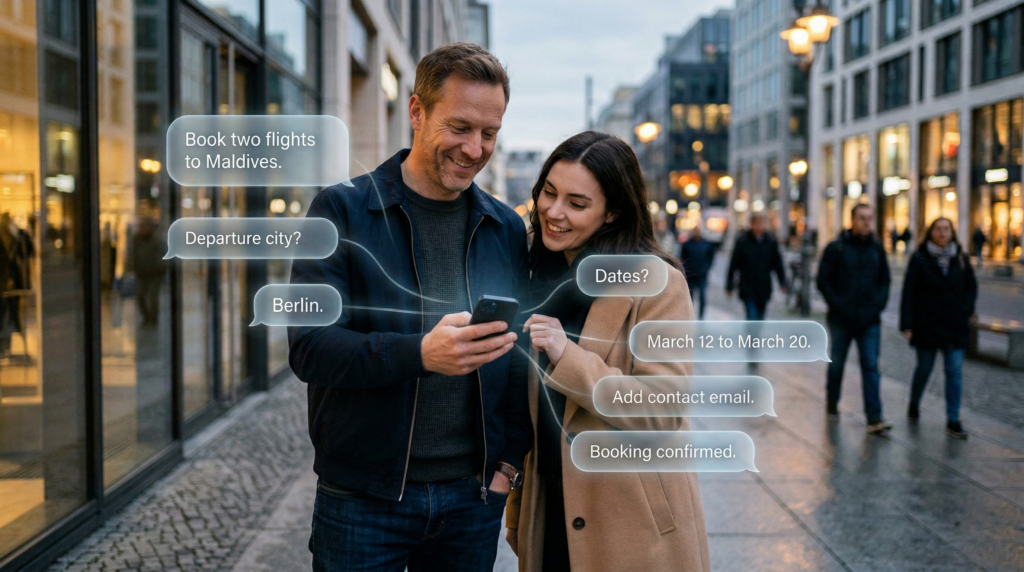
An AI chatbot is an intelligent, conversational system that interacts with visitors in real time. Unlike traditional chat widgets that rely on fixed scripts or button-based flows, an AI-powered chatbot understands natural language, detects user intent, and delivers context-aware responses.
Instead of forcing users to click through rigid menus, it allows them to ask questions naturally, just as they would in a real conversation.
From Scripted Bots to Conversational AI
Traditional bots typically:
- Rely on predefined keyword triggers;
- Follow rigid decision trees;
- Break when questions are phrased differently;
- Provide static, limited answers.
An AI chatbot operates differently. It understands meaning rather than exact wording, maintains conversational context, and generates relevant responses dynamically.
This shift from rule-based automation to conversational intelligence significantly improves the online experience.
How It Actually Works
A modern AI chatbot platform uses natural language processing and machine learning to analyze user input, identify intent, and retrieve accurate information in real time.
When trained on company content such as website pages, FAQs, or product documentation, the chatbot becomes a reliable digital extension of the business, capable of delivering consistent and accurate answers at scale.
More Than Just Customer Support
An AI chatbot does more than answer questions. It can guide users toward the right solutions, capture and qualify leads, book appointments, and connect with CRM systems through integration.
Rather than acting as a basic support tool, it becomes a conversational layer that transforms a static website into an interactive, responsive online experience.
Why AI Chatbots Are No Longer Optional
Customer expectations, competitive pressure, and the speed of digital interaction have changed the standard for doing business online. What was once considered an innovation is now becoming a baseline requirement.
Here is why.
Customers Expect 24/7 Availability
The internet never closes, and neither do customer expectations.
People research products, compare services, and make purchasing decisions at any time of day. If they have a question and cannot get an immediate answer, many will leave and continue their search elsewhere.
An AI chatbot for website ensures:
- Instant responses at any hour;
- Support across time zones;
- Continuous availability without increasing staffing costs.
In a global digital economy, round-the-clock availability is no longer a competitive advantage, it is the minimum standard.
Speed Directly Impacts Conversions
Online users have limited patience. Delays create friction, and friction reduces revenue.
When visitors must:
- Search through multiple pages;
- Wait for email responses;
- Fill out long contact forms.
they are far more likely to abandon the process.
A conversational AI chatbot removes that friction by providing immediate answers, guiding users step by step, and helping them move forward confidently.
Fast interaction builds trust. Trust increases conversion.
User Experience Now Drives Business Growth
Customer experience has become one of the strongest differentiators in modern markets.
A website that feels interactive, helpful, and responsive creates a stronger impression than one that feels static. Conversational interaction helps to:
- Reduce confusion;
- Simplify decision making;
- Make complex information easier to understand;
- Create a more human-like online experience.
Businesses that prioritize experience consistently outperform those that focus only on products or pricing.
Scaling Support Without Scaling Costs
As website traffic grows, so do customer inquiries. Hiring and training large support teams is expensive and time consuming.
An AI chatbot platform can:
- Handle thousands of conversations simultaneously;
- Answer repetitive questions automatically;
- Escalate only complex cases to human agents.
This allows businesses to scale efficiently while maintaining consistent service quality.
The Competitive Landscape Has Changed
More companies are adopting AI solutions to enhance their online presence. Businesses that delay implementation risk appearing outdated or unresponsive.
In many industries, customers already expect a conversational interface when they visit a website. Companies that provide it create a smoother journey. Companies that do not may lose engagement before the conversation even begins.
The reality is simple. An AI chatbot for website is no longer a future innovation. It is a necessary foundation for delivering the level of speed, convenience, and experience that modern customers demand.
How Businesses Should Use AI Chatbots
Implementing an AI chatbot for website is not simply about adding a chat window. The real impact comes from thoughtful design, proper training, and seamless integration into the overall customer journey.
Here is how businesses can use AI chatbots strategically to deliver a truly improved experience.
Make the Experience Truly Conversational
A chatbot should feel natural, not robotic.
Instead of forcing users through rigid menus or scripted flows, the experience should resemble real dialogue. An effective conversational AI chatbot should:
Understand intent rather than rely only on keywords
Respond in clear, human language
Maintain context throughout the interaction
Ask relevant follow-up questions when needed
The goal is to guide users smoothly toward answers or actions without friction. A conversational approach reduces frustration, increases clarity, and builds trust.
Train the Chatbot on Real Business Knowledge
An AI chatbot is only as strong as the information behind it.
To provide accurate and helpful responses, businesses should train it using their actual knowledge base, including website content, FAQs, support documentation, and product details. Information should be reviewed and updated regularly to ensure reliability.
When properly trained, the chatbot becomes a consistent digital representative of the company, delivering accurate answers at scale without variability.
Integrate the Chatbot Into the Customer Journey
A standalone chatbot offers limited value. Real impact comes from integration.
Connecting the chatbot to key systems allows it to move beyond basic conversation and actively support business processes. This may include CRM systems for automatic lead capture, sales pipelines for follow-up automation, messaging platforms for omnichannel communication, and booking tools for scheduling demos or consultations.
With proper integration, the chatbot becomes a central touchpoint in the online experience rather than an isolated feature.
Focus on Value, Not Just Automation
The purpose of an AI chatbot is not to eliminate human interaction, but to enhance it.
Chatbots are most effective when they handle repetitive questions instantly, pre-qualify leads before they reach sales teams, assist users during purchasing decisions, and escalate complex cases when necessary.
When implemented thoughtfully, automation strengthens the team by allowing human experts to focus on higher value conversations.
Continuously Measure and Improve
Improving user experience is an ongoing process, not a one-time setup.
Businesses should monitor performance metrics such as common customer questions, drop-off points within conversations, conversion rates influenced by chatbot interactions, and overall satisfaction feedback.
These insights make it possible to refine responses, optimize conversational flows, and continuously improve performance over time.
When used strategically, an AI chatbot for website becomes more than a support tool. It becomes a dynamic, conversational layer that improves clarity, reduces friction, and elevates the entire online customer experience.
How Chatigen Helps Businesses
Choosing the right AI chatbot platform matters as much as deciding to implement one. Chatigen enables businesses to launch a powerful, conversational AI chatbot for website quickly and without technical complexity.
Intelligent, Intent-Based Conversations
Chatigen understands user intent rather than relying on rigid scripts. It processes natural language, handles typos and incomplete questions, and maintains context throughout the conversation. The result is accurate responses, smoother interactions, and a stronger user experience.
Fast Setup, No Coding
You can train Chatigen using your website, PDFs, or company documents and go live in minutes. The visual no-code editor makes updates simple, so your chatbot always reflects your latest information.
Built for Growth and Integration
Chatigen goes beyond support. It enables smart lead qualification, real-time contact capture, and dynamic calls to action. With CRM integration via API, including tools like Pipedrive, and connections to WhatsApp, Messenger, Instagram, and website chat, it fits seamlessly into your existing ecosystem.
Chatigen is not just a chatbot, it is a scalable conversational layer designed to improve experience and drive growth.